Kindle Unlimited: Friend or Foe?

This week Amazon added their Kindle Unlimited subscription service. All KDP Select works are automatically included in the service, although authors are able to opt out, if they choose.

KDP Select has been good to me since I became an independent author. I’ve used the free promotional services and seen an increase in sales and reviews.

Since the roll-out of Kindle Unlimited I have seen articles suggesting this is not a good deal for independents and encouraging us to leave KDP Select and offer our books on a variety of sites, such as Smashwords, Kobo, iBooks, etc.

The main downside to leaving the exclusive KDP Select program would seem to be losing my access to Amazon’s Countdown Deals and free promotions.

I would love to hear from other independent authors on the pros and cons of our options in light of Kindle Unlimited.

For me, and for many others, I suspect,  marketing and promotion is the trickiest part of the adventure of being an independent author.

Vain Pursuits included in summer Italian-themed Kindle Bundle

Beginning this weekend, an amazing bundle of five full-length novels is being offered on Amazon for only 99 cents.UTISbannerHOR


Along with my Bunny Elder novel, four Italian-themed works by successful authors Candida Martinelli, Maria Grazia Swan, Beate Boeker, and Julie Sarff are included for your summer reading enjoyment.

If you love romantic Italy or if a visit is still on your bucket list, reading through these delightful romantic mysteries will let you take a virtual Italian vacation without the hassle of airplane travel.

This bundle is only available this summer.


This is not a competition

I must admit to being way too competitive in almost every area of my life. I can’t even join an exercise class for fear of hurting myself trying to be the fastest, strongest, etc. So, I’m doomed to mostly solitary workouts.

I figured writing should be the ideal activity for me. It is already solitary with no one to compete with but myself, right? Not necessarily.

Once my books began to sell and be reviewed, I found myself mentally competing with other independent authors, especially those in my genre. How self-defeating.

There are enough readers “out there” to share.

Competing with my peers is counter-productive when there is so much to gain from networking and supporting one another.

I learn something about myself with every book I write, and now I’m beginning to learn even more as I move into publishing and promoting.

A competitive spirit may be wonderful for the professional athlete, but I think it is something to overcome for me in my writing career.

Vain Pursuits reviewed on Italophile Book Reviews

ItalyIt was such an encouraging surprise when my book, Vain Pursuits (Bunny Elder Adventures Book 2) was reviewed by C. Martinelli on her wonderful Italophile website,

http://italophilebookreviews.blogspot.com/search/label/Naples

The book came to her attention because it takes place in Italy and, after reading it, she was kind enough to post a very flattering review on Amazon.com.

In Vain Pursuits Bunny and her sister, Linda, travel to Italy to purchase an authentic Neapolitan presepio, or Christmas creche, for Linda’s collection of nativity sets.

The two sisters travel from Venice down through Italy to Naples, inadvertently attracting the sinister attentions of the Italian Mafia on their way.

My oldest son married an Italian girl and has lived in the Veneto region of northern Italy for more than twenty years. I visit them whenever I can. Writing this book was an opportunity for me to relive and share many of my impressions of this beautiful and gracious country and its people.

Of course, my own experiences were nothing like those of Bunny and her sister. I’ve never knowingly encountered any mafiosi, for one thing. However, their flight to Italy which opens the story was inspired by one memorably unpleasant real-life thirteen-hour ordeal over the Atlantic.

While one reader felt the book put too much emphasis on the Italian countryside and its attractions, many readers seemed to appreciate the local color.

It is always a balancing act when trying to give the reader a feel for a particular place. Too much detail bogs the story down while too little leaves your characters floundering in a featureless space.

I tried in this book to share the atmospheric items that struck me the most powerfully on my first visit to Italy, without turning the book into a tourist brochure. I hope, for the most part, I succeeded.

Ouch! That hurts, thank you.

One thing both independent authors and traditionally published writers share is criticism. However a work gets published, once it is “out there” it is fair game.

The first time I hit the “Publish” button, I felt physically ill, for fear readers would hate my book. When I received my first print copy I could not even open it until my son read it and assured me it was all right.

I was fortunate that all my early reviews were positive and I even relaxed enough to joke about the fact that the only non-five star review came from my hard-to-please sister, who gave the book four stars.

Inevitably, a dreaded poor review was posted. I was so distressed I almost gave up on finishing the series I’d outlined.

Going back and re-reading the criticism, like probing a toothache, I suddenly realized what that two-star review meant. This reader had read the whole book and cared deeply enough about the characters to write and complain about the way some of them behaved. It wasn’t my writing that was objected to, after all.

That insight helped salve my hurt feelings (somebody doesn’t like me!) so I can now read my reviews with an eye to learning from them. It helps to find out what my readers expected, or wanted, to happen to my characters.

After four published books and many reviews, both positive and critical, I’ve also come to accept the fact that I can’t please everyone. The very same aspect of a story for which I receive praise from some readers can be the most strongly objected to by others.

Whenever a reader of one of my books cares enough to take the time and effort to post a review, pro or con, I am grateful.

Like the subtitle for that wonderful classic Peter Sellers movie, “Dr. Strangelove,” I have learned to stop worrying and love the critics.


Am I a real author?

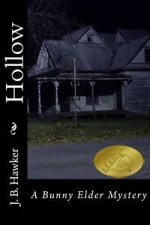
Nearly three years ago when I finally finished my first novel, Hollow, and published it through Amazon’s CreateSpace, I felt apologetic when people asked about my publisher, responding with some version of, “Oh, I’m afraid I just published it myself.”

When friends asked me to sign their copies of the book I was embarrassed and treated it as a joke, “Keep that for when I’m a famous author, ha ha.”

As of today, I have four books of a mystery/thriller series in print and for Kindle. They are available, not only from Amazon, but at many book stores and my local library.

I’ve been interviewed for the local newspaper and a regional publication, each time feeling that I must apologize for not being a real author.

Since being honored by indieBRAG for Hollow, I’ve begun to rethink my attitude.

Yes, I haven’t made enough money to quit my day job, but while working at a very demanding full-time position with my county department of education, I have managed to write, edit, format, create cover design, publish and promote four full-length novels.

I have absolutely nothing to be ashamed of. Although fairly modest amounts, I receive royalties every month.

My digital books have been downloaded around the world, with sales in the US, UK, Canada, Australia, Italy, Germany and India. Print editions have been sold in Canada, the UK, Italy and here at home.

Yes, by gosh, I’m a real author. And if you read my reviews, you’ll see I’m a darned good one.

I’ve got nothing to be ashamed of. And, if you are an independent author, neither do you.

Priorities of the Independent Author

Like many (can I say most?) independent authors, I support myself by working a full-time job.

Since completing the Bunny Elder Adventure series, publishing a new book every six months, I had planned to use some of my precious writing time to promote my published works and set a more leisurely pace for my current project.

This is proving more difficult than I’d anticipated for a couple of reasons.

One, a common theme in a lot of the expert advice encourages regular, rapid output to establish a readership base.

When I read, “publish on a regular schedule, whether one book every six months, or a book each month,” I was stunned to think my two-books-a-year schedule was the outer limit, rather than the Herculean task I’d previously considered it to be. Heeding this advice would have me concentrating on rushing my next book to completion, leaving no time for promotion and marketing.

My second issue sjuggling timeurprised me even more: promotion takes a lot more of my creative energy than writing. Writing, although occasionally hard, slogging work, is still my joy and a natural creative outlet.  Self-promotion, even just learning the ways and means of marketing, runs counter to my personality, leaving me completely drained, in no shape to work on the new book.
This is probably not an issue for those authors who have the luxury of independent means or who have already started earning enough to quit their day jobs, but what is the answer for those of us still doing double-duty in the rat race?

I would love to hear any solutions or suggestions.


Writer’s Block? What Writers Block?

We all hear a lot about the struggles writers can have coming up with the next plot turn, but I struggle with the opposite problem, something I call writer’s rush.

Once the plot has been outlined, the main characters roughed in and I begin writing the first chapter of the narrative, I must constantly rein myself in so as not to hurry to the climax or give away plot points too early.

I’m near the end of the first chapter of my current work and already feeling the familiar tug to speed to the ending.

The technique I’ve been using to prevent my books from becoming short stories or novellas is to decide ahead of time what I want to accomplish in each segment. I bracket that goal on the page before I begin, and then paragraph by paragraph reread what I’ve written, comparing it to what’s in the brackets. When I’ve covered some point, I delete it from the brackets and when the brackets are empty I am ready to move on to the next chapter. In this way, my first rough draft moves at approximately the pace I want.

Of course, goals change and those draft chapters will be revised many times before I am ready to send the work for editing, but the basic structure remains.

If you deal with a similar issue, I’d love to hear how you handle it.


Work in Progress

I am currently in the outline and characterization stage of my next J.B.Hawker novel.

Naidenne Grinager and Rev. Scott Davidson (introduced in the Bunny Elder series) have been married for about a year when the story opens. They are living in the Bannoch Community Fellowship church parsonage.

Other characters introduced in the Bunny Elder series who will reappear in the new book (working title “Bannoch-by-the-Sea”) are Naidenne’s friend, Shirley; Scott’s sister, Rosamund; and her now-widowed nemesis, Maureen Oldham.

New characters being developed are bank manager, Len Spurgeon; Miss Dot, the ancient quilting lady living near Cannon Beach; escaped convict from Pelican Bay, Carver Schramm; Eskaletha Evans, wife of the pastor of the AME church; Judith Falls, Olivette Vernon and Elizabeth Gilbert, other pastor’s wives in the Bannoch community and friends of Naidenne.

I will be trying to give a more in-depth look into the life of a typical pastor’s wife while at the same time weaving a thrilling adventure story.

The Bunny Elder series books were published at the rate of one every six months. Rather than attempt to keep up that pace, I have set a target publication date for “Bannoch” for late Spring 2015.